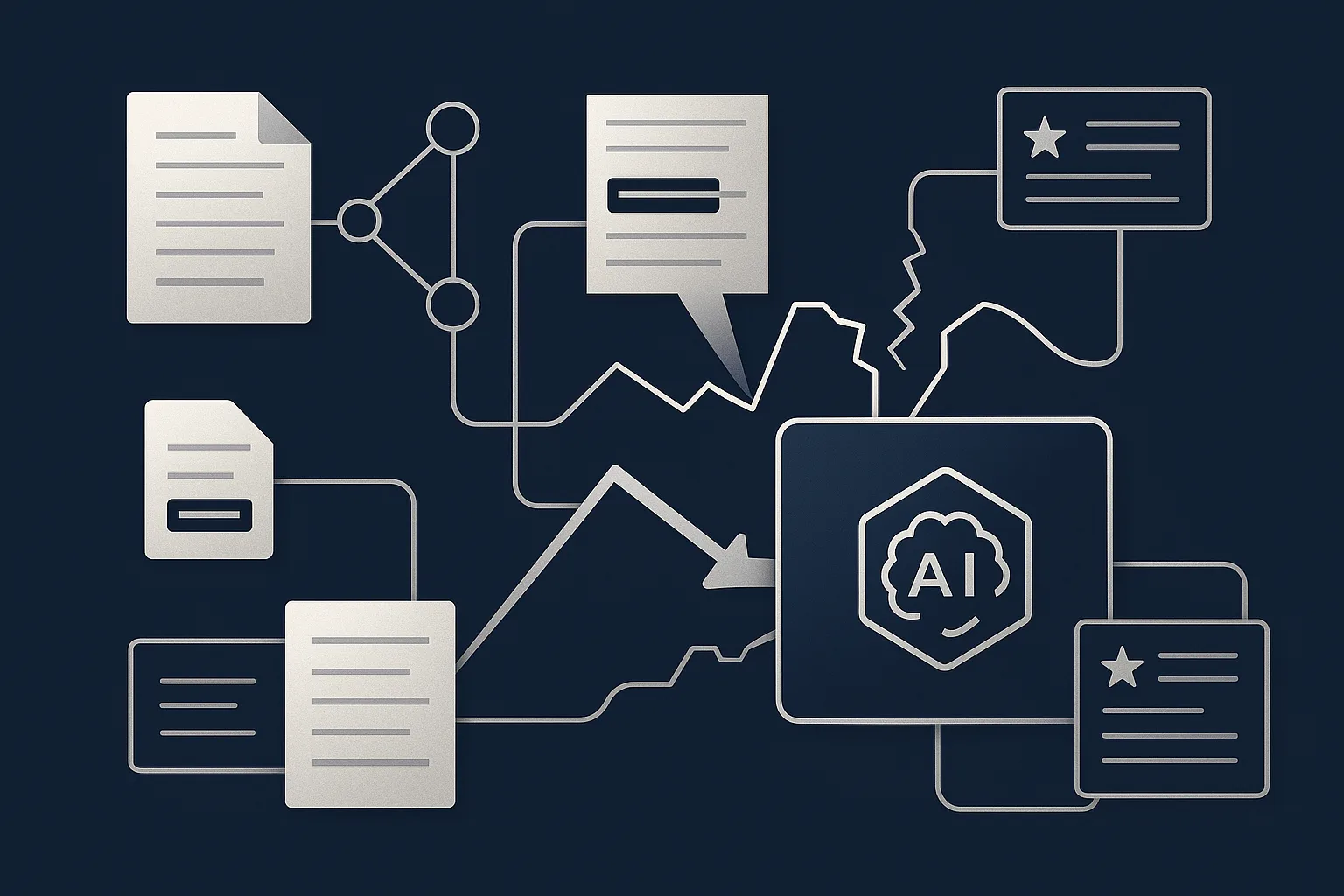
AI citations without clicks are breaking attribution because brands are influencing buying decisions inside ChatGPT, Perplexity, and Gemini without generating the sessions that GA4 was built to count.
That is the core measurement problem in GEO right now. Marketers still expect visibility to show up as a visit, a source, and a conversion path. AI systems increasingly work differently. A user asks a question, gets a synthesized answer, sees two or three cited brands, remembers one, and converts later through branded search, direct traffic, or a sales conversation. The influence happened. The click never did.
This is why so many teams are underestimating AI visibility. They look in analytics, see modest referral traffic from ChatGPT or Perplexity, and conclude the channel is still too small to matter. That reading is wrong. The channel is often bigger than the referral data suggests because a growing share of its impact is invisible to last-click and even multi-touch attribution.
The evidence keeps stacking up. Search Engine Land’s recent framing of “LLM nudges” points to a real shift in post-answer behavior, where follow-up prompts and assistant suggestions shape what users compare, shortlist, and do next. At the same time, recent reporting on AI traffic measurement shows B2B teams actively trying to separate ChatGPT, Gemini, and Perplexity behavior because normal analytics logic no longer captures the journey cleanly. And multiple reports now reinforce the same uncomfortable point: Perplexity citations and Gemini answers can shape brand consideration without producing proportional site sessions.
That is not a reporting bug. It is a structural feature of AI-mediated discovery.
Why classic attribution undercounts AI influence
Classic web attribution assumes a fairly simple chain. A user sees a link, clicks the link, lands on your site, and then either converts or enters a trackable funnel. Even when the path gets messy, the basic unit is still the same: the session.
AI discovery breaks that unit in at least four ways.
1. The recommendation often happens before the click decision
When a user asks, “What is the best AI visibility tool for a mid-market SaaS?” the AI may summarize the category, cite a few brands, explain tradeoffs, and recommend one path. That recommendation can do most of the persuasion work before the user decides whether to visit anything at all.
In traditional search, ranking well gave you a chance to earn the click. In AI search, being cited can shape the buyer even when the click never happens.
That matters because the citation itself functions like a compressed brand impression plus a trust transfer. The assistant has effectively said, “this source is relevant enough to support my answer.” That carries weight.
2. Referrer data is inconsistent across platforms and paths
Some AI-driven visits show up with recognizable referrers. Some do not. Some sessions arrive through copied URLs, opened browser flows, or assistant handoffs that strip or obscure source data. Some users see your brand in AI, then return later through direct navigation or branded search. To analytics, that later visit looks detached from the original AI exposure.
This is one reason teams are now trying to build engine-specific AI traffic dashboards. The problem is not only volume. It is source reliability.
3. Zero-click behavior is normal, not exceptional
We already covered the zero-click shift in our 2026 analysis of search behavior. AI systems intensify it. If the model answers the question well enough, many users never need the source page. They still learn the brand. They still absorb the recommendation. They just do not click.
A cited brand can win mindshare without winning the session.
4. AI journeys are iterative, not linear
A buyer might ask ChatGPT for options, ask Perplexity for comparisons, ask Gemini for implementation risks, then visit one vendor directly two days later. That journey spans multiple systems, multiple prompts, and often zero explicit referral markers.
Your CRM sees a demo request. Your analytics sees direct traffic. Your AI visibility platform sees that your brand was cited in the question set that matters. Only one of those systems is close to the truth of what happened.
The new reality: AI citations create demand that analytics misses
This is the key strategic shift. AI citations are not just traffic sources. They are demand-shaping events.
That sounds abstract, so make it concrete.
If Perplexity cites your category page in a comparison answer, but the user does not click, three things can still happen:
- they remember your brand name n- they search you later on Google
- they mention you in an internal shortlist discussion
Only one of those may show up cleanly in analytics, and even that one may be misattributed.
This is why referral sessions alone are now a weak proxy for AI performance. They still matter, but they capture only the narrowest part of the channel.
The stronger model is this:
| Layer | What happens | What analytics sees |
|---|---|---|
| Citation | AI names or cites your brand in an answer | Usually nothing |
| Recall | User remembers or screenshots your brand | Nothing |
| Consideration | User compares you later through search or direct visit | Often branded search or direct |
| Conversion | User submits, buys, or books | Often credited to last-touch channel |
The value leakage is obvious. A channel can create the first three layers and get credit for none of them.
Why this is especially dangerous for B2B teams
B2B teams are more exposed to this than most consumer brands because their journeys are already long, multi-touch, and research-heavy.
A SaaS buyer may use AI during category discovery, problem framing, vendor comparison, implementation planning, and internal justification. Not every one of those moments produces a click. But every one can influence who makes the shortlist.
This is why the current obsession with raw AI referral traffic is too narrow. If you only count sessions from AI engines, you miss where the business value actually compounds: earlier in the buying process, before the user ever lands on your site.
It is the same mistake marketers made years ago with dark social. A channel was shaping demand, but because the tracking was messy, many teams underinvested. AI citations are the new version of that problem, just with a stronger recommendation effect attached.
What to measure instead of only counting AI referral traffic
Do not throw away traffic data. Expand beyond it.
A workable AI attribution model in 2026 should track five layers.
1. Citation presence
First question: are you cited at all for commercially relevant prompts?
If your brand is absent from ChatGPT, Perplexity, and Gemini responses in your category, attribution debates are premature. You do not have enough visibility yet. Start with presence, not perfection.
2. Citation share across prompt clusters
Track how often your brand appears across a set of priority prompts relative to competitors. This matters more than a vanity screenshot from one lucky prompt.
The useful unit is the prompt cluster, not the isolated query. For example:
- best AI visibility tools
- how to measure AI citations
- GEO software for SaaS
- ChatGPT brand monitoring tools
If your presence across the cluster rises, influence is likely rising too.
3. Brand lift in downstream channels
Look for changes in:
- branded search volume
- direct traffic
- demo requests mentioning AI tools or assistants
- sales calls where prospects reference ChatGPT, Gemini, or Perplexity
None of these alone proves causation. Together they create a much better picture than referral traffic alone.
4. Assisted conversion signals
Your forms, call notes, and CRM should explicitly capture whether buyers discovered or validated you through AI tools. Most companies still do not ask this. They should.
A simple field like “Did an AI assistant influence your research?” is crude, but it is better than pretending the channel does not exist because GA4 cannot see it cleanly.
5. Response quality and positioning
Being cited is not enough. You need to know how you are being positioned.
Are you framed as a leader, a niche option, a budget alternative, or not recommended at all? Are competitor comparisons favorable? Are feature descriptions accurate?
This is why AI visibility monitoring has become its own category. The market is reacting to a real reporting gap.
A better attribution framework for AI-mediated discovery
If I were rebuilding attribution for GEO from scratch, I would use a three-bucket model.
Bucket 1: Direct AI traffic
This includes sessions with clear referrers from ChatGPT, Perplexity, Gemini, Copilot, and similar sources. Keep tracking it. It is the cleanest measurable output.
Bucket 2: AI-assisted demand
This includes branded search growth, direct traffic lift, and conversion paths where the prospect later reports AI influence. It is not perfectly attributable, but it is directionally meaningful.
Bucket 3: AI visibility health
This includes citation share, competitor comparison outcomes, answer accuracy, and prompt coverage. These are upstream indicators that explain future demand even before traffic catches up.
Most teams today overfocus on Bucket 1 because it looks familiar. The smarter teams will build operating systems around all three.
What high-signal teams are doing now
The best teams are not waiting for perfect attribution. They are building approximation systems that are good enough to make better decisions.
That usually looks like this:
- Define 20 to 50 commercial prompts that matter.
- Monitor brand and competitor citation rates weekly.
- Tag AI referrals separately in analytics.
- Add AI influence questions to forms and sales intake.
- Compare AI visibility changes against branded demand and pipeline trends.
- Refresh content and entity signals when visibility drops.
This is less elegant than classic SEO reporting, but it is much closer to reality.
It also aligns with the bigger trend we have been tracking at searchless.ai: discovery is decoupling from the click. That does not make measurement impossible. It just makes lazy measurement obsolete.
How content strategy should change when clicks are no longer the full story
If AI citations can create value without sessions, then content strategy needs to optimize for citation quality and memorability, not just click-through probability.
That means:
- answer-first openings
- strong entity clarity
- explicit product positioning
- comparison-ready language
- current stats and source-backed claims
- FAQ sections that match real buyer questions
This is exactly why listicles, comparison pages, and structured explainers perform well in AI environments. They are easy to extract, easy to cite, and easy for users to remember.
We covered the source-selection side of this in our breakdown of what content gets cited by AI. The attribution implication is the next step: if your content is citable but not clicky, it may still be economically valuable.
That should change how teams evaluate ROI.
The wrong conclusion to avoid
A lot of teams will hear this and say, “If AI citations do not send many clicks, maybe the channel is overrated.”
That is the wrong conclusion.
The right conclusion is that your measurement model is lagging behind user behavior.
Marketers made this mistake before with podcasts, dark social, communities, and word of mouth. The channels that were hardest to track often got dismissed until they became too important to ignore. AI citations are on the same path, except the scale may move faster because the interfaces are already mainstream.
If your brand appears repeatedly in AI answers for category-level questions, you are building distribution, whether analytics gives you clean credit or not.
If your competitor appears repeatedly and you do not, they are accumulating invisible advantage.
What to do this quarter
If you want a practical plan, do this now.
1. Stop using AI referral sessions as your only KPI
Keep the metric. Demote its importance.
2. Build a priority prompt set
Use commercial, comparison, and solution-aware prompts, not just informational ones.
3. Track share of answer, not just share of click
Measure how often you appear and how prominently.
4. Instrument your CRM for AI influence
Add form fields, intake questions, and sales-note tagging.
5. Align content with citation mechanics
Prioritize structured pages that answer, compare, and clarify. This is where GEO and attribution meet.
6. Benchmark your visibility now
A baseline matters because AI behavior changes fast. You need to know whether your presence is growing, flat, or collapsing.
The simplest starting point is a visibility benchmark at audit.searchless.ai. It will not solve attribution on its own, but it gives you a much better upstream signal than GA4 alone.
FAQ
Why do AI citations often not show up in analytics?
Because users can see and act on a citation without clicking it. AI assistants often answer the query directly, and follow-up behavior may happen later through branded search, direct traffic, or offline discussion. Standard analytics tools were built to count sessions, not invisible recommendation effects.
Is AI referral traffic still worth tracking?
Yes. It is still the cleanest direct signal from AI platforms. It is just incomplete. You should track it alongside citation share, branded demand lift, CRM-reported AI influence, and competitor visibility.
What is the best KPI for GEO in 2026?
There is no single best KPI. The strongest setup combines citation presence, citation share across commercial prompt clusters, AI-attributed or AI-assisted pipeline signals, and downstream brand lift such as direct traffic and branded search.
Why are B2B companies hit hardest by this attribution problem?
Because B2B buying journeys are long and research-heavy. Buyers often use AI for vendor discovery, comparison, and internal validation before ever clicking a site. That means AI can shape the shortlist long before analytics records a visit.
How can I tell if AI visibility is influencing pipeline?
Look for directional patterns: higher citation share, more branded search, more direct visits, form responses mentioning ChatGPT or Perplexity, and sales calls where prospects reference AI-generated recommendations. None is perfect alone. Together they are useful.
What should I do first if my attribution model ignores AI?
Start by benchmarking your brand’s AI visibility, defining a prompt set that matters commercially, and adding AI influence capture to your CRM and forms. That gives you both upstream and downstream evidence to work with.
Free AI Visibility Score in 60 seconds -> audit.searchless.ai